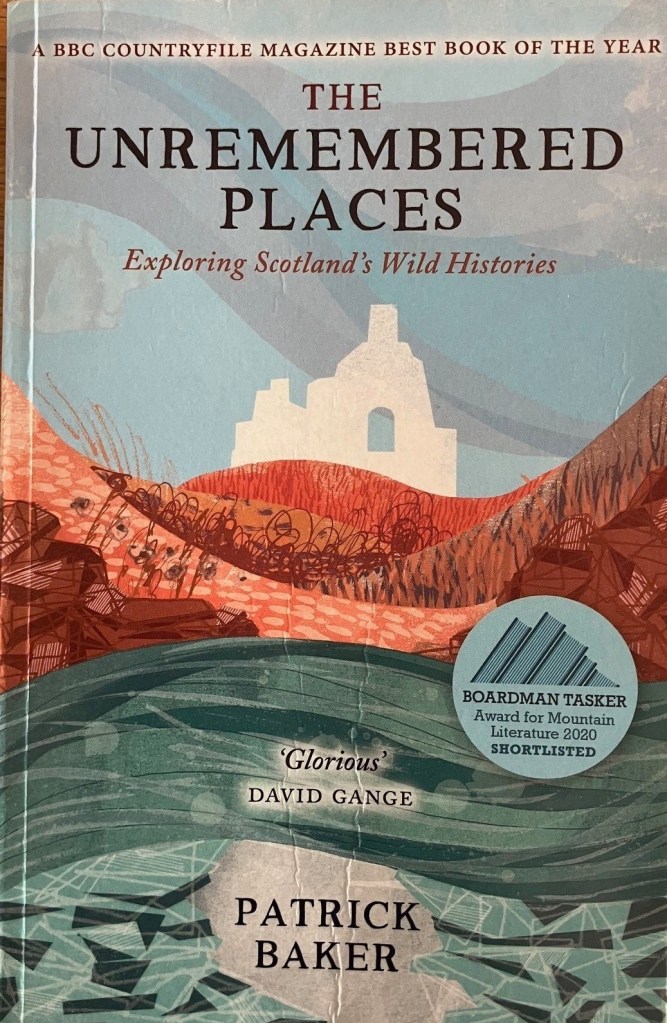
Roger Deakin wrote of “unwritten places”, Baker of wild histories and wild places, recalling times and places he describes as inconsequential and commonplace. He cites Christopher Tilley on the archaeology of phenomenology, experienced by walking through the landscape.
The book has two constants, the separate history of Scotland and the way evidence of the economies and societies of the past persist hidden in plain sight.
There was a tradition of island burials reflecting the sanctity of island locations but also providing protection against bodies being scavenged by wolves. Baker describes the lochs as routes for the Christianisation of what became Scotland. He refers to crannogs without considering them in detail. He describes limestone cave systems in Assynt in North West Scotland and Inchkeith in the Firth of Forth, which in 1547 was held by the English, who were ousted by a Franco-Scots force with the French in turn ejected by the Scots. With the Catholic Mary Queen of Scots still reigning in 1560, Catholicism was outlawed in Scotland. Following the Restoration there was persecution of Presbyterians in South West Scotland by the “Highland Host”.
Baker visits Kinlochlevan an isolated community where electricity was used for aluminium smelting but which was kept separate from the navvies who built the aqueduct feeding the damned reservoir providing power. These transient unsettled groups of working men were a constant up to the First War. Think of the navvies employed in the failed St Catherine’s Harbour in Jersey.
He paddles to the Slate Islands in the Inner Hebrides, from where roof slates where shipped world wide. Empty roofless houses surround former quarries flooded by storm surges. Kevin Mansell and I camped here from where we kayaked to the nearby Garvellachs, depopulated islands, the site of a Dark Age monastic settlement.
In Scotland British military bases represent the geography of placement, not passage. From the mid-18th century there were massive droves of cattle and sheep into Central Scotland and on into England. They moved at up to 16 km a day, using short routes of traditional local transhumance. Local paths, connecting neighbouring districts, when joined up created long-distance routes. Drovers were compared to (and became) warriors. Because of the threats to them, drovers were exempt from the (anti-Jacobite) Disarming Acts of 1716 and 1748.
Lairds who led and prerserved traditional clan groups were succeeded by debt burdened landlords who cleared communities for sporting estates and sheep. Property rights in turn were trumped by the established rites (and rights) of passage in a law case, which went to the House of Lords bankrupting both the landowner and Scottish Rights of Way & Recreation Society.
Illegal distilleries hidden in the landscape meant the difference between poverty and survival for communities. The tradition continues in Scotland’s whisky industry. Herring, smoked in Kippers and Arbroath Smokies, were fished by communities on Scotland’s east coast until the shoals disappeared as the result of overfishing from the 1960s

