Assessment 10 out of 10
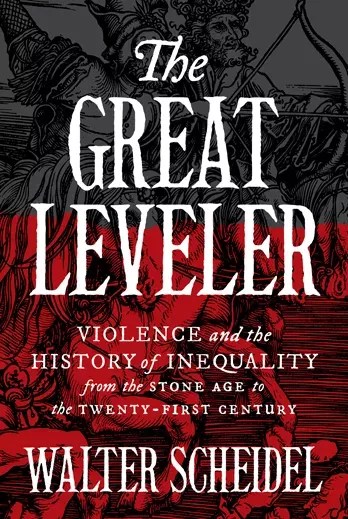
This is a great book taking a long view of history. My experience at University was of New Geography based on models. This is New History involving models. My high assessment isn’t to say that this is an easy read. It isn’t.There are four core arguments.
First human inequality is the norm & in periods of stability inequality will increase. This has been so at least since the Neolithic Revolution’s adoption of agriculture. It may also apply to some hunter/ gatherer communities eg the settled groups of the Pacific Northwest, dependent on salmon fishing, berry gathering & hunting marine mammals.Sedentary agriculture led to increased population & settlement size and ultimately to urbanism. It also facilitated the build-up of armies and armed conflict, resulting in pillage & enslavement both increasing inequality, which increased with the size of polities. Empire building increased slavery, the Roman Empire the most slave owning society in history, its élites building up land & slave holdings across its provinces.Earnings from capital & land holdings exceeding the earnings of labour contributed to the normalcy of inequality, so do premiums paid to the technologically skilled compared to the unskilled.
Second inequality has only been reduced as a result of violence, the Great Leveller which has taken four forms, the Four Horsemen of the Apocalypse
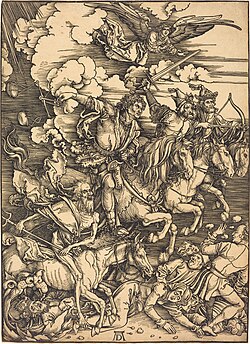
The Four Horsemen of the Acopolypse by Albrecht Durer
Mass mobilisation warfare. This reduced inequality because of the need to increase the numbers fighting and their fitness to fight, notably in the Great Compression of 1914 to 1970. In the west mass mobilisation war during the Great Compression was funded by soaking the rich, in autocracies by printing money & borrowings which were ultimately unsustainable, in Nazi Germany by pillaging its continental Empire. Scheidel doesn’t say this, but this resulted in reduced income inequality for Germans and the Volksdeutsch. See Hitler’s Beneficiaries, Plunder, Racial War & the Nazi Welfare State by Gotz Ali. Following the defeat of Japan, the US imposed on it New Deal like reduced inequality.World history is one of recurrent warfare, but mass mobilisation warfare was infrequent. Armies were small because the land wouldn’t sustain large forces, whilst large armies encouraged outbreaks of plague. During the long period of the Thirty Years War fought in & around Germany over time the size of armies fell.
Violent Revolution in Russia following WWI, China following WWII and Cambodia where the murderous Khmer Rouge regime was able to seize power after spillover from the Vietnam War. These violent revolutions led to reduced inequality, but at the price of millions killed, starved or condemned to Gulag Archipelagos. In Russia, when there was no longer a class enemy to destroy, as they had been murdered, died in the civil war or fled, to suit Marxist ideology, Stalin invented one in the kulaks, relatively prosperous peasants, who were then exterminated.The French Revolution was different. The Revolution 1789-99, rather than following mass mobilisation and war came before it, with Levée en Masse and the Revolutionary Wars (1792-1802) continuing until 1815 in the Napoleonic Wars. Despite overseas expressions of horror at the French Revolution (see for instance Edmund Burke’s Reflections on the Revolution in France), Scheidel emphasises that the violence of the French Revolution was nothing like at the level of the later Marxist Revolutions, and consequently its effect in reducing inequality was significantly less. The French Revolution did follow the costs and deaths of the Seven Years War, but these were on quite a different scale less than 200,000 to Russian deaths in WWI perhaps 3.5 million or Chinese in WWII 12 million.
Plague The Black Death breaking out in the mid-14th century was followed by persistent renewed outbreaks. Population had grown rapidly in the High Middle Ages with inequality rising substantially. The Black Death reversed this pattern, returns to capital and landholding falling & returns to labour increasing, the pattern reverting to the normal one of increasing inequality from the 16th century until the Great Compression of the 20th.
State Collapse Scheidel argues Violent Levellers 1) – 3) were infrequent disrupters to the normal pattern of high and increasing inequality and, taking the long view, State Collapse more frequently brought about significantly reduced inequality. Quoting the archaeologist Colin Renfrew on systems collapse and social transformation archaeology reveals the “cessation of rich traditional burials… abandonment of rich residences, or their use in impoverished style by squatters… and cessation of the use of assemblages of luxury goods.”, exactly the situation in Britain following Roman withdrawal in the early 5th century CE. With the fall of the predatory regime of Siad Barre in Somalia in 1991, whose government (such as it was) largely existed to benefit the dictator & his allies, data suggests social welfare has improved in the failed state, a modern example of an old pattern.
As Durer’s woodcut print suggests the Four Horsemen shouldn’t be viewed seperately but as riding together. In Russia, following the deaths and disruption of WWI, as many as 10 million died in the Revolution and Civil War,1.5 million military and 8 million civilians from famine, epidemics, mass execution and state breakdown and in China 5 million 1927-37 and 6 million in the renewed conflict 1945-49, with perhaps 80% of deaths civilians.
Third events which were thought might have contributed to reducing inequality, generally didn’t Land reform, Debt Cancellation, Peasant Revolts usually crushed, Civil Wars, resulting generally in no more than a change in those in power, and Famine. Famine, unlike plague, didn’t often lead to reduced inequality as famines didn’t frequently recur. In Ireland the Potato Famine accompanied and was followed by persistent emigration with similar effects to recurrent plague, but this didn’t necessarily reduce inequality, at least in the short term, for those remaining in Ireland. The poorest couldn’t afford the passage to emigrate. There was an increase in farm size with the smallest holdings consolidated into larger farms increasing inequality.
Fourth there wasn’t a break point after which reduced inequality was achieved by peaceful constitutional means. With globalisation bringing an end to the equalising effects of the Great Compression, with finance industry incomes benefitting from deregulation and wealth offshored, the period since the 1970s saw reversion to the normal pattern of income inequality increasing in periods of peace and stability.
 Of Books, Bikes & Islands