This is a difficult book to score. Let’s start with the weaknesses before focusing on its strengths.
Translated from the French, it is not the easiest read. By the sections and chapters covering social, political, cultural & economic topics in turn there is inevitable repetition. It could be rewritten to be half as long. There are a couple of schoolboy errors, Southampton supposedly relacing Coutances as Jersey’s episcopal see and there being no French invasions between 1066 and 1781. Editing should have picked these up.
However, the story is an important and under-studied aspect of Jersey & French history, throwing light on the question of island identity.
Successive groups fled persecution and regime change in in France, Huguenots, who influenced Island Protestantism and apparently the adoption of knitting, royalists, who disastrously in 1795 took part in the counter-revolutionary attack on Quiberon., Victor Hugo, who was accused of writing disparagingly of Queen Victoria and Island institutions and had to leave for Guernsey, and finally, with growing anti-clericalism, the Catholic religious until a 1902 Law prohibited religious groups of more than 6 settling. None of these successive refugee groups aimed to stay. Their goal was to return to France.
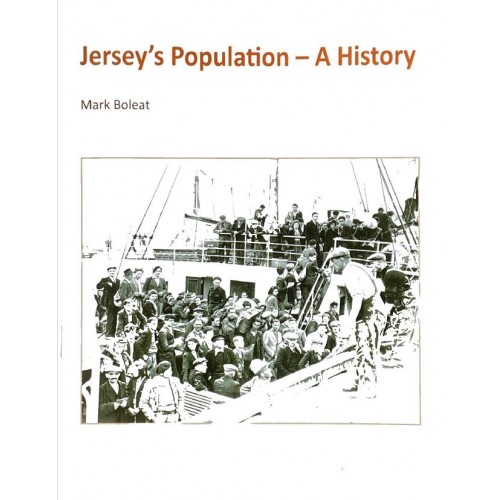
In parallel with reading Monteil, I read Jersey’s Population; a History by Mark Boleat (Société Jersiaise 2015). This summarises secondary sources and provides a useful counterpoint to Monteil. Boleat emphasises that the smaller the area studied, the more changes in population reflect immigration & emigration and certainly in Jersey that that these were a function of economic activity.
Jersey’s population increased from 28,600 in 1821 to 57,020 in 1851, primarily the result of English-speaking immigrants, half pay officers, artisans and labourers. Much of the increase was in St Helier. In 1821 it comprised 36% of the Island’s population, increasing to 54% by 1871, yet its status remained that it was one of 12 parishes. This contrasts with Guernsey where in 1821 St Peter Port had over half the population with a population density ten times the rest of the island. St Peter Port has always been more dominant in Guernsey than St Helier is in Jersey.
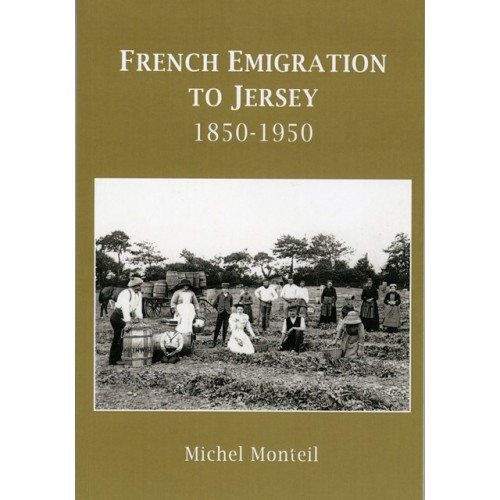
Quite different both from the French political and religious refugees and British immigrants was the other immigration from France essentially after 1850, reflecting a sea change in Jersey’s agriculture from mixed farming & cider orchards (25% of agricultural land at the end of the 18th century and only 3.5% by 1900) to cattle rearing and growing new potatoes favoured by the south to north island slope and availability of vraic as fertiliser. Agricultural labourers came over to harvest potatoes in a short six-week period. which coincided with a relatively quiet time in French agriculture. Workers came from La Manche, Morbihan and predominantly from Côtes d’Amor where 90% of the population still worked in agriculture.
The French authorities complained that those moving to Jersey included draft dodgers, but with population registers maintained by the parishes who were unwilling to share them with the French consul, they couldn’t be traced. Plus ça change.
During a long period including the 2nd Empire and 3rd Republic, France opposed emigration, except “internal” emigration to Algeria (considered part of France). It hardly noticed 3,000 seasonal labourers who sailed to Jersey. However, some of them chose to stay, rather than returning after potato picking ended, working in hay making and during the winter looking after cattle. Eventually some stayed more permanently based on individual decisions. Jersey was unusual in its farming population increasing between 1851 and 1911 with an increase in small farms, rented land comprising 2/3rds of agricultural land. Jersey law prohibited non-British purchase of land. French families used the possibility of nue-propriété by their Jersey born children to get around this restriction.
Between 1851 and 1921 there was out-migration from Jersey to Australia. NZ, the US, and England. By 1900 there were 10, 000 Jersey born in England. In addition, there were fewer English, Irish & Scots immigrants than there had been in the early 19th century growth period. The result was a population reduction in the second half of the century, which would have been greater without the French workers who stayed. By 1901 Jersey’s population was 51,500 plus a garrison of 1,000, 7,000 had been born in Britain and 6,000 in France with 38,000 born in the Island, including French descendants, so that perhaps 13,000 out of 51,000 were of French descent.
19th century censuses indicate a significantly higher female than male population in the Islands reflecting absences at sea and fishing when the census took place and the importance of women working in service, which contributed to a male bias in emigrants. Query doesn’t this also reflect a bias in economic emigration generally?
The French were found in the northern agricultural parishes, except initially “remote” St Ouen, contrasting with the concentration of British immigrants in St Helier, with other British concentrations in Gorey working in the oyster beds and wooden shipyards and the wealthy in St Brelade.
The cultural linguistic question is complex. Those from La Manche spoke a Norman dialect very similar to Jèrriais, most of the Bretons spoke Breton. Formal French was used in the Law and in the States, English only permitted there from 1900. However as early as 1855 there were 11 newspapers, 5 in French, 6 in English. The French was formal French with columns beginning to appear in Jèrriais.
Did the Bretons avoid using French and were anti-French? That 2,500 returned to France to enlist in 1914 suggests they remained loyal.
Monteil contrasts the cultural attitudes of French and British immigrants to Jersey. The British did not marry Jersey born spouses. In St Martin half of marriages were mixed of which the vast majority were with French spouses. half men and half women. The French did not read Jersey newspapers. They didn’t form French cultural groups & associations. This contrasts with the British, who formed their own groups and clubs and petitioned the UK Parliament & Privy Council about things they disliked.
French newspapers criticised the British in the Boer War, contributing to anti-French feeling and eventually a riot sparked by British soldiers in St Helier in 1900 on the relief of Mafeking.
A 1906 States Committee on Immigration was concerned with the effects of the net emigration & increase in French influence, of Jersey becoming “less British” It was followed in 1909 by a law requiring a 50shilling deposit, proof of identity & health. Embarkation was allowed only at St Helier or Gorey. Monteil, argues the French staying on adapted (& were suited to) the rural & insular Jersey identity, integrating by becoming involved in parish life, more Jersey than the Jersey folk themselves. The next generation spoke English, interpreted as the language of the successful, as happened with immigrants to the US and Commonwealth. So, the 1906 Committee’s concerns may have been unfounded.
The French discouraged Bretons working in Jersey in 1919 and 1920, after the wartime losses and damage. The British wanted Jersey instead to use British labour, who were found not up to the effort involved.
The Jersey population fell by 10,000 with the German Occupation. Perhaps 20,000 left Guernsey despite its smaller population. This included 75% of school children. During the Occupation there was a steady reduction in population due to German deportations and to an excess of deaths over births indicating that it was the young who had left. There was a rapid growth in population following Liberation so that by 1951 population exceeded what it had been in 1939, Jersey 57,310 compared to 51,080 Guernsey 43,534 compared to 41,000. Query what proportion of the net immigration in the post-war period were returning Islanders?
Boleat summarises Rose-Marie Crossan’s “Guernsey 1814-1914 Migration and Modernisation”. Guernsey’s population did not grow as rapidly as Jersey’s in the first half of the 19th century and continued to grow in the second, when Jersey’s fell. Her figures emphasise the general point that net migration figures are often misleading and frequently understate both emigration & immigration, so in 1841-51 there were 6,103 immigrants and 5,568 emigrants (net immigration 535) and in 1881-91 4,541 immigrants and 5,206 emigrants (net emigration 665). There was evidence for step migration from France via Jersey. After working on the potato harvest in Jersey, some went on to Guernsey to work in Guernsey in its quarries and agriculture. By 1901 the French were four times what they had been in 1841, accounting for 5% of Guernsey’s population compared with 11% for Jersey.
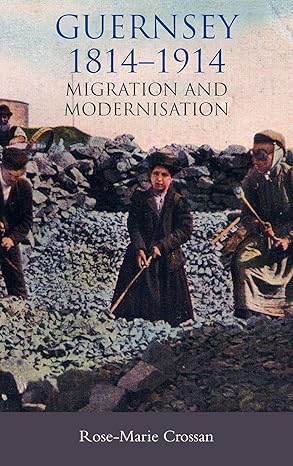
Crossan highlights the short-term nature of much migration. 30,000 individuals could be identified as immigrants to Guernsey from census enumerators’ records 1841-1901, but of these 2/3rds appeared in one census only. Economic conditions continued to attract newcomers, but many left to return home or were attracted by better opportunities elsewhere, circumstances which have continued, certainly in Jersey. The high turnover of migrants helps explain the background to Crossan’s view that in the 19th Guernsey changed from a francophone to anglophone society.
 Of Books, Bikes & Islands