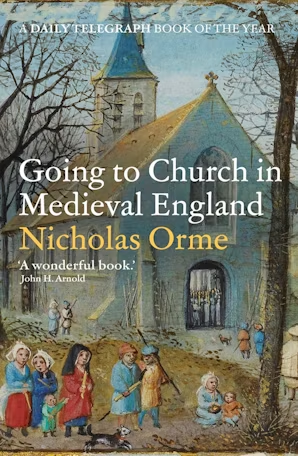
I recommended this book but, on reflection, thought it a difficult choice for our book club. It is well illustrated and good value for what is an essentially an academic text. However, it is closely printed, and each page had to be read and re-read.
Sections I found interesting,
Some of the first Dark Age churches were Mynsters, Anglo-Saxon for monasteries. They were both this & centres of evangelisation. The 11th and 12th century proliferation of English parishes happened locally, rather than by plan, with parish churches often close to manorial sites. Contrast Jersey’s 12 parish churches, which do not coincide with seigneurial fiefs and were not linked to seigneurial seats, the parishes apparently established in the 11th century by planning by the Bishop of Coutances.
In England there were some 9,500 parish churches and perhaps three times as many chapels, in Jersey 12 parish churches and evidence for 55 chapels, so a higher number of chapels to churches? Chapels were chapels of ease distant from the parish church, private chapels and those of cults, including guilds.
The landscape was Christianised with crosses and holy wells. Most of these have disappeared in both England and Jersey, but many more have survived in (Catholic) Brittany.
Cathedrals were not for the laity but for ceremony praising God, Catholic liturgy based on that in lay (i.e. non-monastic) Cathedrals was poorly suited to parish churches. Churches are divided between nave & chancel, with powerful laity encroaching into the chancel, supposedly restricted to clergy. In the 12th century there were walls between the two linked by a fairly narrow archway, switching to a more open space, elaborated by rood screens with the adoption of Transubstantiation, the “Real Presence”, the host held up for believers. Laity generally only took communion once a year at Easter, which was obligatory, putting pressure on the clergy.
The year was marked by holy days, themselves reflecting Christian theology, Lent, Easter, Ascension, 40 days after & Pentecost ( In England Whitsun), 50 days after Easter, when the Holy Spirit supposedly descended on the Apostles, Corpus Christi, a late addition to the cycle of festivals, recognizing the Real Presence in the host and a range of Marian festivals , including Candlemas, 40 days after the Nativity and marking the purification of the Virgin, and Assumption on 15 August , Anne’s birthday, which remains a Bank Holiday in Republican France!
Churches may not have included seating. To this day Catholic churches, contain movable chairs, Protestant pews being associated with static services. Processions around & in the Church and through the parish were disliked & suppressed by reformers, who objected to the accompanying celebrations. They continue in Catholic countries, for instance in Breton Pardons.
The Church opposed magic, but “Prayers and practices came close to magic in supposing a particular formula could have a specific effect, when embraced by the pious”, indulgences granted for saying particular prayers or sold by pardoners (Aka charlatans.)
Change occurred with literacy, moving from images to words, the literate following the mass in missals.
So a book to dip into and follow up particular interests, rather than one to read from cover to cover.
 Of Books, Bikes & Islands