Assessment 9 or 10 out of 10
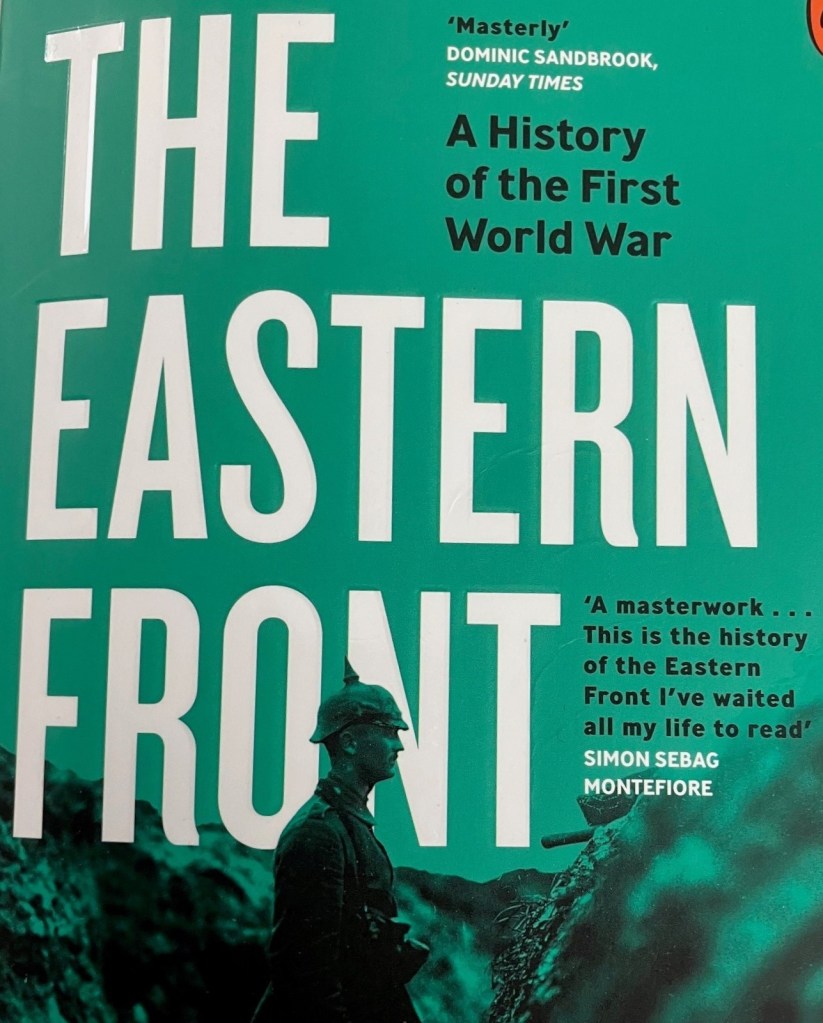
This is a great book with good maps (often the weakness of military histories), a glossary, dramatis personae and wonderful photos. It was an easy read. If it had a fault, it was that it was so fast moving, you wanted it to be longer.
Lloyd explains how the different theatres of the Eastern Front interact, the long border zone between Russia and Germany and Austria Hungary, Tyrol and the Isonzo Front between Austria and Italy and struggles in Serbia, Macedonia, Montenegro and Rumania and how they tie in with the war on the Western Front. Place names changed, there were population expulsions and exchanges, borders shifted and have changed again so tracing the site of action can be difficult.

Getty Images
The Russian 1st Army advanced south of East Prussia and was encircled at Tannenberg. The same thing didn’t quite happen to the 2nd Army and early in 1915 to the 10th, establishing German superiority on the Eastern Front.
Czarist government was chaotic with constant changes, the Imperial family influenced disastrously by Rasputin. Most of the Russian generals named seem to have been murdered in Lenin’s Soviet bloodbath or killed in the Russian Civil War.
The Central Powers had the advantage of inside lines, able more easily to link forces fighting on the Eastern and Western Fronts. However, the Allies had at least 50% more troops. The Central Powers also suffered from the naval blockade.
Italy joined the Allies in May1915 with the expectation of benefitting from Austrian collapse and not declaring war against Germany until August 1916. Civil rights were restricted for a third of the Italian population, its Army disciplined brutally. The Italians fought 11 battles on the Isonzo Front west of Trieste but then were nearly encircled in a “near death experience” by the Germans and Austrians using new tactics in the Caporetto campaign of 1917.
Falkenhayn as German COGS was not seeking a decisive battle but fighting a war of survival, attacking Verdun throughout 1916 not to achieve breakthrough but to suck in French counterattacks. Hindenburg & Ludendorff pressed on from East Prussia into Lithuania & Courland but were held back by Falkenhayn who didn’t want to be dragged into endless Russian wastes, a lesson the Germans might have heeded in WWII. Replaced as COGS he fought a successful war including using cavalry against Rumania.
The Austrian Army had numbered up to 4m, 70% of those eligible were drafted. 780,000 were killed or died of wounds, 1.6m became prisoners, 0.5m were discharged because of wounds. With the collapse of Russia, former prisoners began to return but this was balanced by Russians who had been working in industry and agriculture being released. Later in the war Hungary supplied wheat to Germany, whilst the Austrian population was starving. The German army was better fed than the Austrian. The Emperor Karl put out was feelers to the Allies, but conservatives were opposed to greater democratisation, the Dual monarchy tied in more closely to Germany, left that it would either fail or survive with Germany.
Czarist government was chaotic with constant changes, the Imperial family influenced disastrously by Rasputin. Most of the Russian generals named seem to have been murdered in Lenin’s Soviet bloodbath or killed in the subsequent civil war.
Austro-Hungarian losses in 1915 were the high point of Russia’s war, the Austrian army and Empire sacrificed on Conrad’s insistence. The effects of the war broke the links within the Empire with the irreplaceable loss of regular officers with an understanding of ethnic languages. In 1916 the Brusilov offensive effectively destroyed much of the Austrian Army, Conrad having to turn to Falkenhayn for help.
The Austrian Army had numbered up to 4m, 70% of those eligible drafted. 780,000 killed or died of wounds, 1.6m prisoners, 0.5m discharged because of wounds. With the collapse of Russia, former prisoners began to return but balanced by Russians who had been working in industry and agriculture being released. Later in the war Hungary supplied wheat to Germany, whilst the Austrian population was starving. The German army was better fed than the Austrian. The Emperor Karl put out was feelers to the Allies, but conservatives were opposed to greater democratisation, the Dual monarchy tied in more closely to Germany, left that it would either fail or survive with Germany.
The Soviets made huge concessions at Brest-Litovsk. Lloyd thinks German failure was not making peace at this their highpoint, instead going for total victory in 1918, a “gambler’s last throw”. They were forced to forego the land won and the independence of the client states set up in Ukraine & the Baltics at Brest Litovsk, struggles still with us.
 Of Books, Bikes & Islands