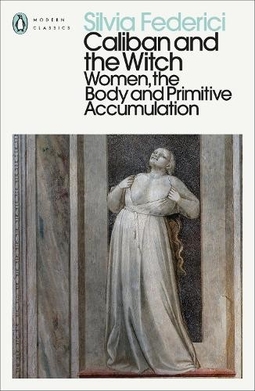
Caliban & the Witch, the Body & Primitive Accumulation by Silvia Frederici Assessment 3 out of 10
Leonard & I take it in turn to buy the books selected for review. It was his turn to buy Caliban & the Witch ( the title comes from Shakespear’s Tempest) & before reading it, dropped it in for me to read. He warned “I am sure you will give up. It looks awful.”
I persevered, as the subject, Europe in the late Middle Ages & Early Modern period, interests me.
There are good things, the lithograph illustrations & detailed notes.
There are some descriptions which are interesting and ring true; in the feudal village all work contributing to the family’s sustenance. Women worked in the fields, as well as raising children, cooking, washing, spinning & keeping the herb garden. The domestic was not devalued as it was in the money economy. Much of women’s work was done communally, contributing to their power, despite, for instance, canon law allowing wife beating.
Overall, Frederici fails the New History Test of judging those described by the standards, knowledge & beliefs of their time. Throughout you are put off by her Marxism.eg the commutation of labour services into fees “co-opted the goals of social division, contributing to the disintegration of the feudal village, “but of course the nucleated village wasn’t everywhere the norm.
The gang rape in Italian cities of unmarried lower-class women (Frederici writes “proletarian women”) was sport for young men, described as a “class protest at being forced to postpone marriage …which undermined class solidarity.” What Frederici could emphasise but didn’t is the inherent violence of such cities, vide “Romeo & Juliet.”
Her focus is on “Primitive Accumulation”, according to David Harvey, himself a Marxist, “a process which entailed taking land, say enclosing it and expelling a resident population to create a landless proletariat, and then releasing the land into the privatized mainstream of capital accumulation”. This is history as a zero-sum gain, in which a class is separated from the means of production, which became privately owned. Marx himself referred to the Spanish production of American gold & silver and the enslavement of Africans as sources of accumulation. Frederici concentrates on enclosure and witch hunts.
Enclosure is a bète noire of left-wing academics, but what is described as enclosure took place over a long period and in different forms. It included the enclosure of commons and changing farming organisation from open fields farmed communally to individual farms, which facilitated agricultural modernisation. However generally enclosure didn’t change those owning the land. Enclosure did result in the pauperization of poorer peasants who had depended on the commons to survive, whilst better off peasants had larger shares of the commons and a greater share in the land once open fields were divided up, in the same way that they had farmed larger strips making up the open fields.
Other factors contributed to changes in rural power & land ownership. The Notes included the table shown below. Change occurred on Dissolution of the Monasteries, what the great WG Hoskins called the Age of Plunder. The Crown seized Church land, which was then sold to the gentry and yeoman/freeholders, the enriched property-owning classes. to finance Henry VIII’s wars. The beneficiaries included the Cromwell and Fairfax families, Parliamentary leaders in the 17th century English Civil War.
According to Frederici, the new owners shortened leases, racked rents and evicted tenants. What did occur was increased vagrancy when there was no longer the option of medieval pilgrimage and social provision by monasteries. She describes workhouses as the criminalisation of the working class. Shouldn’t that be of the poor & destitute?
The effect of colonisation was to reduce by up to 90% the population of the Americas whilst Europeans feared population decline. Frederici refers to the 30% population decline in 17th century Germany, incredibly without saying that this was the result of the terrible destruction and disruption wrought by the Thirty Years War.
She suggests the early modern European witch-hunts were intended to suppress women and address the fear of population shortage. Women traditionally acted as midwives & provided contraception, abortion & infanticide. What had been women’s skills was now assumed to be that of witches, while male doctors took over obstetrics, with the intention that population growth was not held back, increasing the proletarian class who would work for capitalists. So capitalists persecuted witches.
Certainly, women were predominantly the victims of witch hunts, including suffering sexual sadism. However, there are a range of explanations of witch hunts wider than Frederici’s Marxist trope.
She notes that witch hunts appeared in areas where there had been the most intense persecution of heretics, Southern France, the Jura and northern Italy. This was true of the earlier witch hunts; However, the greatest number and half of all deaths were in Germany[1]. German folk culture adopted the concepts of demonological witchcraft thoroughly, so that rather than witch hunts being aimed at destroying rural community life, rural communities were active participants in witch hunting, German witches (hexen) above all were accused of being weather magicians. Persecutions were concentrated in wine growing areas, particularly susceptible to poor weather, other regions with more robust economies or favourable micro-climates suffered less. Local feuds gave rise to accusations of witchcraft.
Witch hunts took place competitively in both Catholic & Protestant areas. The Holy Roman Empire’s patchwork of states and principalities meant there were different outcomes in different areas. witch hunts concentrated in ecclesiastical micro-principalities, which the prince bishops couldn’t challenge as they sought to maintain independence from larger neighbours. Dillinger argues that the more complex the legal system the less likely were witch hunts. He describes many ecclesiastical territories as failed states using torture, untrained judges & the immediate (in)justice of witch hunting groups.
A similar pattern of small jurisdictions, religious/political conflict and the use of torture resulted in the large number of witch trials in lowland Scotland and Guernsey, which Frederici at one point refers to as part of England.
Linking her two fetishes, witch hunting and enclosures, she suggests that the particular English concentration of witch hunting by the Witch Hunter General in Essex was the result of this being an area of early enclosure. In reality a major factor was that the usual condition of legal control in England broke down during the Civil Wars.
In Germany witch-hunting declined with the awfulness of the Thirty years War. Numbers of witch trials trailed off with the growth of administrative power in the Great Reform period which followed the end of the war. For instance, in 1652 witch trials were simply banned in Electoral Trier.
So this was book which prejudged its explanation, ignoring the local and whose actors were classes not individuals, the author ( I wanted to write authoress) joyless.
[1] Johanes Dillinger Germany, the Mother of the Witches (2019)
 Of Books, Bikes & Islands