Why I chose it:
The two top topic suggestions for the book club to read around were Scottish history followed by witchcraft.
Review
I have given the book a high score as it is both illuminating and very readable.
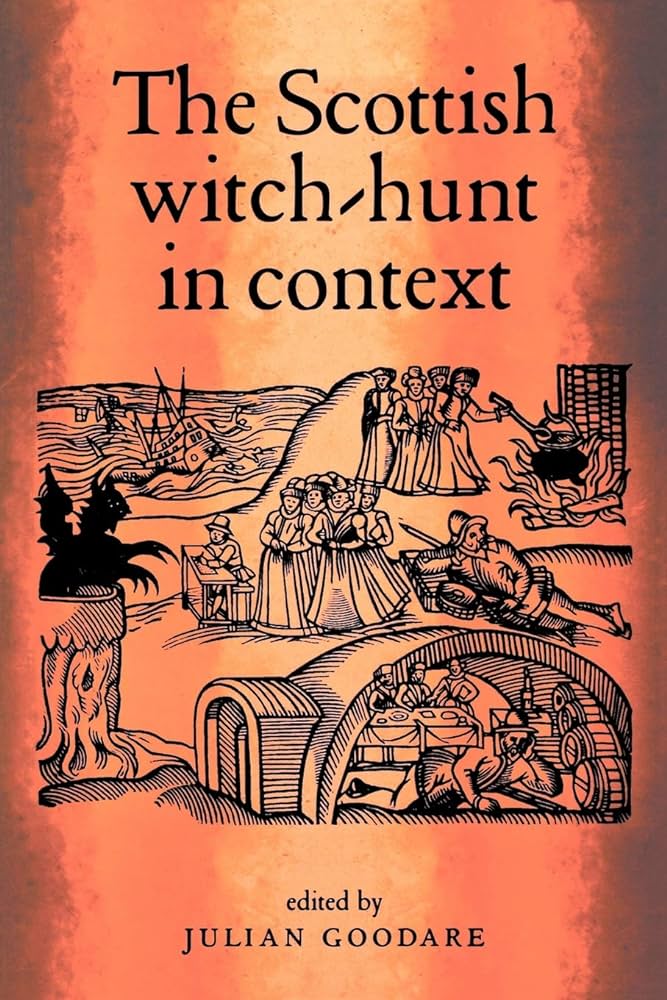
This book is a collection of academic essays on the Scottish witch-hunts covering the period from the later 16th Century to the early 18th. It considers the factors contributing to the purges and the decline of witch-hunting. The contributors place belief in witches and the panics around witchcraft in folklore, cultural discourses, gender relations, social class, politics, religion, and moral regulation by the church and state. A couple of chapters draw comparisons with witch-hunting in England and Europe.
Scottish Context:
Lowland Scotland in particular was an area of relatively intense persecution with witch-hunts that were more severe than those of most European States. At a conservative estimate Scotland executed over twice as many witches, probably more than a thousand to England’s 500. Some writers claim it was more like two thousand. Given the relative size of their populations at the time, Scotland’s execution rate was something like ten times that of England.
The Scottish persecutions came in 5 great waves (1590 -1; 1597; 1628-30; 1649; 1661-2). Trials and executions more often involved groups of accused, rather than individuals who had fallen under suspicion, as was the more usual pattern in England. However, in 1645 in the Eastern counties of England, 250 witches were tried and upwards of 100 were executed.
A number of explanations are put forward for the greater degree of persecution in Scotland:
- The extent to which the notion of the godly state[i] was internalised.
From the late 15th century onwards the evangelisation of the populace coincided with the emergence of nation states. New regimes require ideological conformity. The new commonwealth (1649) is an obvious example of the enforcement of ideological conformity and moral cleansing, but the process of internalisation of these values was already well underway before then. It is argued in Chapter 11 that because of the existing strength and maturity of the English state, the notion of the godly commonwealth never took off to the same extent in England.
- Scotland experienced multiple crises in the 1590s-1690s: Political and religious crises, famine and war:
Religious and political turmoil in the 1590s led to a breakdown of cooperation between King James IV and the Presbyterian church and an attempted coup in 1596, followed by a crackdown against the dissidents. 1594-9 saw repeated harvest failures, instances of mass starvation and an outbreak of plague in 1597. Julian Goodare argues that the repeated national panics throughout the period is evidence of a relatively unstable state that was seeking stability.
The Revolutionary Settlement following the Glorious Revolution of 1688 caused political instability. Unrest continued in the Highlands after the 1689 Jacobite Rebellion. The Massacre of Glencoe in 1692 where 30 members of the Clan MacDonald were killed by Scottish Government forces for failing to pledge allegiance to William and Mary undermined the legitimacy of the government. The Protestant ascendancy resulted in a contest between Presbyterians and Episcopalians for control of the Kirk in Scotland. Harvest failures in 1695-9 caused famine and England’s war with France disrupted Scottish trade. A French invasion scare in 1696 was seen not just as a physical threat; the French represented the antichrist, the Roman Catholic church. Witch-hunts tended to thrive during periods of crisis. In seeking to make sense of social and political instability an immediate answer could be found in divine and demonic intervention in the world.
- Fragmented and decentralised legal system
The Scottish legal system was fragmented, decentralised and often presided over by lay judges. The Assize Courts were not always operating as a check and balance to local officials with no official status. Trials without professional lawyers and judges resulted in a greater number of executions.
Other aspects of the book I found interesting:
Gender/social status: 8o% of those accused of the crime of witchcraft were women. They were overwhelming poor and often old. This gender imbalance is tied up with the contemporary discourses around religion, nature, women, power, God and authority. Accusations of witchcraft often centred around women’s work as midwives, milkmaids etc. The witch is characterised as vengeful and quarrelsome – a discourse of social control. The demonic pact was envisaged as a heterosexual relationship between the female witch and the devil.
In marriage contracts of the time a man and woman were united in hierarchy by contract, consummated by sex. So it was with the demonic pact. The devil had access to the witch’s body and dominion over her actions. Women were deemed to be weaker than men and more susceptible. Male witches were believed to come to the devil either via a female mediator or through a master-pupil relationship. Thus, witchcraft was understood through notions of Eve’s fall from grace, her temptation of Adam, hierarchical relations within marriage and, in the case of male witches, master-pupil feudal relations. Although the demonic pact was structurally similar to the marriage contract, it was fundamentally subversive of the marital relationship. In the demonic pact the wife renounced her baptism and her marriage ties because of her adultery with the devil. Thus, female witches were outside the usual boundaries that policed women’s moral and sexual behaviour – husband, church, and God. Lauren Martin, asks whether the association of the devil with women, marriage and women’s work indicates a profound unease with women in society?
The crime of witchcraft: For centuries before 1550 people at all social levels believed in witches and malevolent old women were the stuff of folk tales but there appear not to have been organised witch-hunts. The systematic hunting and persecution of witches came with the Reformation and the development of the modern state and all the upheaval that entailed. The witchcraft statute was passed in 1563, three years after the Reformation. It was not repealed until 1736. In Scotland witch-hunting was a Protestant project, but, whether Protestant or Catholic, early modern reform movements were seeking to impose a new model of Christianity in which ordinary people would be responsible for their own salvation and deviants from the godly norm would face punishment. Hitherto tolerated behaviours became labelled as criminal. The Act set in motion a complex legal machine: local church courts (Kirk sessions), criminal courts and the Privy Council at the level of central government. Even the King himself (James VI) interrogated suspected witches as well as publishing his book Daemonologie in 1597. Thus, belief in witches resulted in large scale prosecutions only when religion was used directly to buttress and legitimise state power. Witchcraft prosecutions had the effect of alleviating social and political tensions, as all could agree on this common enemy. Although accusations began in local communities, witch-hunting and persecution was as much a top-down as it was a bottom up process .
Amplification spiral[ii] and moral panic: Witchcraft was defined as a crime but thought of as more serious than say, theft or assault. Such crimes were against property or the individual, whereas witchcraft was akin to treason, only worse since it undermined the whole society in this life and the next. The amplification spiral would begin with a small number of cases arising in various localities. Once sensitised to the issue, hidden or borderline examples that would not themselves have been noted as anything out of the ordinary were reported as suspected witchcraft and attracted official attention, confirming a pattern. The central authorities would become more worried about witchcraft with each case that was brought to them. A moral panic would ensue based on a widespread feeling of fear that evil stalked the land and threatened the values, interests, and well-being of a community or society.
The decline of witch-hunting: During the late 17th and early 18th centuries prosecutions and executions for witchcraft in Scotland declined and eventually came to an end. The statute of 1736 determined that witchcraft was no longer a crime. However, this did not mean people no longer believed in the existence of witches. Rather they became reconciled to the fact that witches would now be able to live among them without hope of removing them. They were back where they had been in the Middle Ages.
A number of factors contributed to the decline of witch-hunting in Scotland such as the Enlightenment, changes in judicial administration and reaction to the overly zealous witch-hunt of 1661-2. The hunt was large (664 named witches in four counties), and the death toll so great, that attention was drawn to procedural irregularities. A more professional judiciary had led to greater control of the conditions under which it was lawful to arrest and to ‘prick’ suspects, and to use torture to extract confessions. Central government was taking greater control and the Scottish criminal justice system was becoming more centralised and rationalised by the late 17th century. A new judicial scepticism was growing around the idea that events attributed to supernatural agency might have natural causes. They began to require a higher level of evidence to convict. However, the scepticism of lawyers and judges regarding the guilt of witches could not bring about an end to witchcraft executions, as guilt or innocence was still ultimately determined by lay juries. Levack in chapter 10 asserts that the decline of witchcraft prosecutions in Scotland would proceed more gradually than in countries where judges exercised more immediate control over the judicial process such as in France.
I really enjoyed this book. I found it stimulating and I learned a great deal about the underlying causes of the phenomenon of the witch panic. It also gave useful insights into a period when people just like us had a very different way of seeing the world. The witch craze was based not just on popular beliefs but also on a complete intellectual system articulated by renowned demonologists, including the King (James VI).
[i] ‘the godly state’ 17th Century notion that it was the duty of the secular arm of the state to impose the will of God upon the people.
[ii] Stanley Cohen, sociologist.
 Of Books, Bikes & Islands