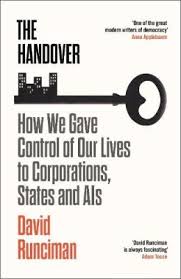
This is a wide-ranging book covering in 275 pages (before notes, index etc) a long view and where we may go from here. Runciman raises a number of questions, each of which justify further investigation. Those include:
- What do States, Corporations and AIs have in common?
They are artificial, non-natural automatons created by humans, but which are given or develop (apparent) agency of their own. In Little Britain the computer said no, but of course it didn’t. It was the programmers who created algorithms which gave the answer no and the operative, who choose not to override or question that response.
States and Corporations have legal personality with (conceptually) permanent existence, potentially able to sue and be sued. It seems unlikely that AIs will have legal personality.
- How Many Singularities?
A Singularity in science is where mathematics misbehave generating infinitely large values. They are found in black holes and it is thought at big bang, The Technological Singularity is a hypothetical future point in time at which technological growth becomes uncontrollable and irreversible, possibly as a result of the adoption of AI, resulting in unforeseeable consequences.
Runciman suggests that there have been or will be, two Technological Singularities, an earlier Singularity facilitated by the Scientific & Industrial Revolutions, which lead to the Demographic Transition and accelerating urbanisation and marks the discontinuity with a world of religion and a later Technological Singularity, which may have begun. We are increasingly dependent, if not on AI, certainly on algorithms to order goods and services, pay taxes etc, We give verbal instructions to Alexa. Bots in Japan talk to the elderly in care homes, keep them amused and remind them to eat. With our necessity for smartphones Runciman suggests we have already become hybrids part human, part machine.
In my view there was a still earlier Technological Singularity when humans switched from hunter gathering to farming, populations became settled, the first towns appeared, hierarchical religion was adopted and we became increasingly separate from the natural world.
- When did States come into being?
Runciman focuses on the publication in 1651 of Thomas Hobbes’s Leviathan. Hobbes favoured a strong monarchical State, which would persist, whatever the abilities, or lack of them, of the monarch. Key was the quality and permanence of State institutions, including courts, the civil service and what became the Bank of England. Runciman thinks of the State as an algorithm.
He suggests England became a State in 1689 with the “Glorious Revolution”, France and the US both in 1789. All these dates are debatable. Hobbes’s Leviathan was published immediately after the English Civil and Thirty Years Wars. With the immediacy of these horrific events and religious wars Hobbes argued that the alternative to strong monarchical government was “war of all against all“. He favoured State religion, following the Peace of Augsburg, “cuius regio, eius religio”, whose realm, their religion, contributing to the maintenance in England of the established church.
There is a paradox here. That Leviathan’s function was to ensure peace but for Weber the State was an association of legitimised violence and Charles Tilly in “Coerciom, Capital and Europen States” wrote that “States made war and war made States.”
There were States before then, but generally they failed as their continuance depended on that of their t founders. There were exceptions, which were sui generis, Runciman mentions the Roman Republic and Empire. Others might be Egypt, China & Venice. However, the significance of a step change in State formation and continuance (around the time of my Second Singularity) is persuasive.
After the step change States were replicable and only replaceable by other States. Most corporations which fail cease to exist. (Runciman mentions those too big to fail). However even failed States eg Afghanistan and South Sudan persist, the world almost wholly made up of Nation States, whose borders in the post-war world have remained remarkably unchanged.
Runciman suggests in passing that Empires are the default mode of organisation and that Nation States may be a temporary aberration. Ideas worth further enquiry.
- The emergence of States, Corporations and AIs
Corporations had antecedents in Roman Law, the Societas (equivalent to a partnership). which doesn’t need a purpose and lacked legal personality, and the Universitas, a separate legal person with a purpose which covered churches, colleges and guilds rather than businesses, but have since multiplied to include corporate businesses.
I was attracted by the view of the Church as a corporation, thinking of the Magisterium in Philip Pullman’s Dark Materials. It helps explain why the Church’s territorial structure & boundaries were often at variance with those of feudal territories.
The existence of corporations depended on the State, which inaugurated the world of modern artificial persons by being both one itself and the creator of further artificial persons, initially established by Charter, then with company law allowing individuals to incorporate companies.
Hobbes was concerned about the power of the City of London as a corporation, which mimicked the State, raising its own militia. There were Company States, the East India Company, and the VOC, the Dutch East Indies Company. They raised armies, taxes and dispersed criminal justice, but ultimately failed by being too commercially driven and subject to corruption.
There has been a huge increase in the number of corporations worldwide with even the most powerful having ever shorter lives. Runciman writes at length about the tech giants and their dominant founders, whose lives and aspirations presage Yuval Noah’s Homo Deus, in control of AI. A possibility he mentions is that AI will or is bringing a reduction in the expansion of the globalised economy.
Tech giants’ increase in power is connected to the needs of the military-industrial complex. There are revolving doors between the tech giants, leading Universities, research labs and politics. The tech giants have in part taken over State function, some of their operations allegedly based on a giant confidence trick with the use of data. They are potentially subversive of politics putting the State at risk. In the west there is an expectation that the State will do everything, but as electors have become consumers, they are increasingly dissatisfied with what is achieved.
China encouraged its own look alikes of the tech giants eg Ali Baba, which enjoyed huge growth but were then held back Xi’s China wanting all AI development in State hands. So there remain two competing models for the development of AI, the West and China.
- The threats we face:
- Global warming leading to increased mass migration.
- Killer bots, already happening with drones
- Biological disaster created by biological manipulation
- Nuclear annihilation
So the first two threats are happening already. Biological disaster may also already have happened, Covid created by biological manipulation, the last threat, nuclear annhilation, only postponed. In the past we might have done terrible things, but this was limited by technological incapacity; no longer. all these threats potentially magnified by AI.
In the meantime, States and Corporations continue to drive for their own growth-based goals. The result is that we have been so successful in taming nature that we have lost sight of how unnatural is the world we have created. Where to now is unclear. I remain personally positive but pessimistic for the world. We have certainly not reached Fukayama’s end of history. If only we had.
 Of Books, Bikes & Islands