This biography explores a man whose life was critical to the disjunction between Medieval and Early Modern Europe. Luther was a theologian and linguist. Roper describes his greatest achievement as the translation of the Bible into German, significantly influencing the creation and development of the German language. What Roper doesn’t say is that he was helped by others in particular in the translation from Greek and Hebrew.
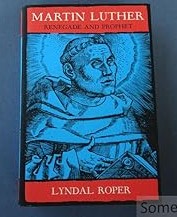
Image of Luther adapted from a Cranach woodprint
Luther’s father leased and ran a copper mine at Eisleben, ruled then by the Counts of Mansfeld. Luther was born there in 1483. Unintentionally it was where he died in 1546 aged 62. Against his father’s wishes Luther became a monk, subject to the austere Augustinian regime. On the advice of his superior and confessor Staupitz, Luther became a priest, which not all monks were, and studied theology. Throughout a psychological explanation is provided for Luther’s thinking and actions. He spent most of his life at Wittenburg in what was then Electoral Saxony. He lived there in the monastery which was linked to and became part of the University and eventually his marital home. Thus both Eisleben and Wittenburg are known as Lutherstadt.
Wittenburg, like other Saxon towns, was a creation of Medieval German colonial expansion. Only Germans could be citizens. There were Slavic Wendish villages nearby. Luther thought “the Slavs the worst nation of all.” Roper notes that, “He shared the colonialists fear of those they had dispossessed.”
Luther was a giant figure of both the Reformation and German history. However this has to be put in the context that he was a prolific writer, which clearly influences historians of periods which we would consider under documented, focusing on what written material is available. Luther was also close to the artist Lucas Cranach the Elder, a leading citizen of Wittenburg, so Luther’s image in paintings and wood cuts were widely distributed. They feature in Roper’s book with 78 pictures within the text and 12 plates.
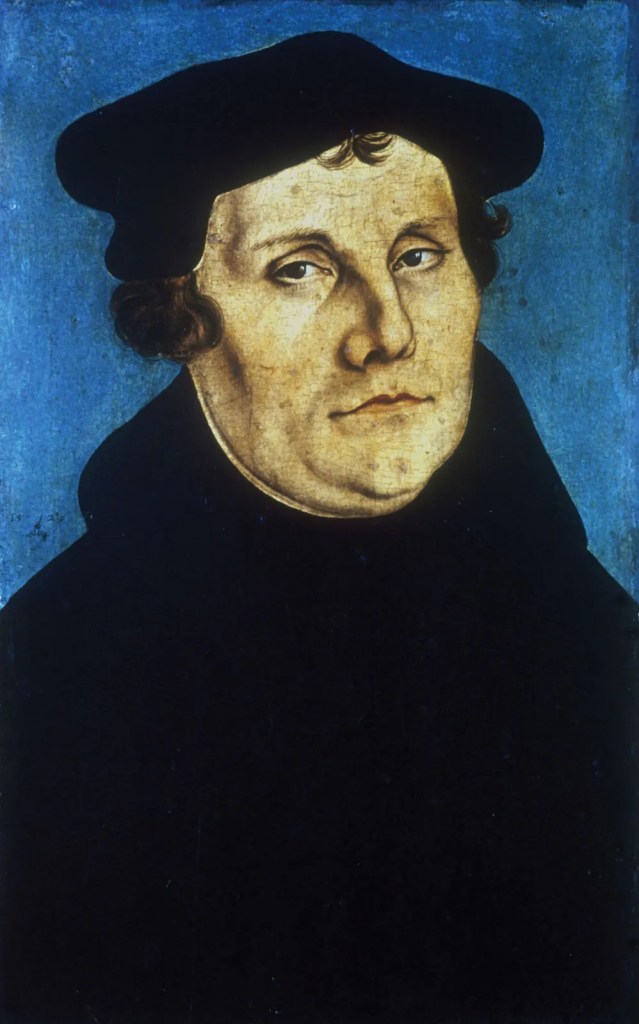
Cranach oil painting of Luther. He remains dressed as a churchman, although no longer as a monk.
Roper writes illuminently on the differences between Luther and other religious thinkers. He believed salvation was restricted to divine intervention justified by faith alone (a word he inserted apparently in the German translation of a passage in Paul’s Letter to the Romans to emphasise his interpretation of the text). This view distinguished him from Catholic belief in good works. In this he parted ways with the Humanist Erasmus, Luther refusing to accept any element of good works. Such thinking influenced the Protestant turn against Mendicant Friars and providing alms for the poor, reformed cities introducing legislation prohibiting beggars and vagrants.
Such thinking contributed to Luther’s hostility to monasticism and indulgences. Indulgences were sold to reduce time in purgatory, whilst part of his objection to monasticism was linked to his objection to private masses and chants by monks for the souls of the departed. Luther indicated that none of this was in scripture. Famously objecting to a sale of indulgences in 1517 he wrote his 95 theses, which may, or may not, have been pinned to the church doors in Wittenburg. It was addressed to the Archbishop of Mainz, so at this time he remained within the Church.
Roper comments on the irony that much of Wittenburg’s wealth came from donations from those visiting the Elector’s collection of relicts, an alternative to longer distance pilgrimage. These funds went to finance the University where Luther was Professor of Theology, but one who then attacked indulgences and relics.
Luther himself ceased to be a monk influencing others to quit the monastic life, leading in Germany to the dissolution of the monasteries rather than Henrician suppression. He was involved in finding husbands for nuns who chose to leave their convents, including marrying a former nun himself. He was however personally misogynistic, sympathetic to Islamist attitudes to women. Roper thinks he was more misogynist than the then norm, as husbands and wives would have worked together in farms and workshops, but Luther spent such a long part of his life in a monastery.
He differed from other reformers in opposing iconoclasm and took a line on the sacraments somewhere between the Catholic belief in transubstantiation and the view that the sacraments were no more than symbolic of Christ’s presence. Tellingly he was opposed to ruling communities according to the ideas of religious correctness.
At the heart of Luther’s theology was his view of the two kingdoms, the powerful as they are (“render unto Caesar”) and the sacred. This helps explains his bitter opposition to the Peasants’ Revolt of 1525/6. Some historians suggest that Luther’s own rebellion against the Church influenced the Revolt. In reality it appears to have been driven by local objections to serfdom and restrictions on communal rights to hunt, fish and gather wood. Nonetheless there was an expectation that he would have been at least sympathetic to the Revolt, which he wasn’t. In this, he was consistent, rebellion was justified against the Catholic church, which had departed from scripture, but this didn’t justify rebellion against princes and lords.
Roper mentions this as one of the ways in his thinking contributed in Germany to Nazi excess. Those in power were to be supported whatever their acts. She notes that his antisemitism wasn’t merely a function of his times, but that he developed antisemitic thinking. Medieval antisemitism provided some degree of toleration, Luther’s went further in wanting to extirpate the Jews. Interestingly, although Roper doesn’t comment on it, both Luther’s and Hitler’s Table Talks were recorded and published by their supporters.
Luther also hated the Pope using scatological language to describe what he thought of as the Antichrist, language, which surely influenced the persistent antipapist virulence of some Protestants.
After reading Roper’s biography, I listened to a BBC podcast , “Power in the Blood, the Life of Ian Paisley. ” I recommend listening to it. Another powerful preacher with political aspiratrions, who formed his own evangelical church, Paisley must be as close as you can get in the recent past to what Luther was like in his heyday.
Roper emphasises Luther’s willingness to take the lead and dispute with Catholic opponents. He was clearly personally courageous. After being declared a heretic and excommunicated in 1520, he publicly burnt not only the papal bull but documents of canon law, another action mirrored in Nazi actions. At the Diet of Worms in 1521 he stood before the Emperor and Imperial Estates still in monkish habit and was unwilling to relent, famously stating ”Here I stand, I can do no other.” Charles V then issued the Edict of Worms, calling on the territories to enforce the church’s excommunication and not publicise his writimgs. It was left to the rulers of the territories constituting the Empire to enforce the Edict and Luther was protected by the Elector of Saxony. Roper doesn’t note that nonetheless the Elector maintained his personal Catholicism.
The intellectual struggles in which Luther was involved continued to resonate. Luther did not necessarily intend to create a new church but to reform the existing church. However his certainty, confidence and tendency to fall out with others contributed to the reformed church fragmenting at an early stage, a tendency which has continued.
Roper’s work reinvigorated my liking of biography as a literary form. It concentrates on Luther as a man and on his developing theology. To understand the significance of both the places and characters involved it helps to have an understanding of the geography and power structure of the Holy Roman Empire with its uncertain limits and constantly changing principalities and mosaic constituents including ecclesiastical territories and “free” imperial cities and all subject to the overlapping, sometimes conflicting, powers of elected Emperors and Popes. In this I was helped by reading in parallel Joachim Whalley’s long and densely written Germany and the Holy Roman Empire 1493-1648, which I can also highly recommend.
 Of Books, Bikes & Islands