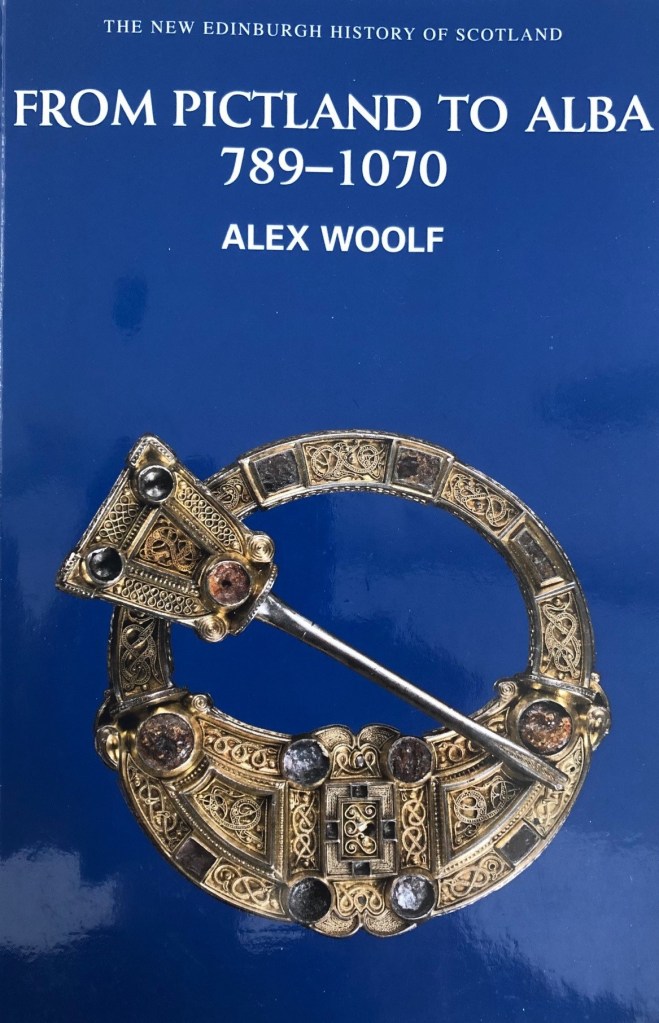
By Alex Woolf (2007)
Assessment 9 out of 10.
I would have given it 10 out of 10, but found the maps no better than average.
The book is divided in three, pages 1-37, the Introduction, 41-271, Events, and 275-350, Process, so 350 pages on what Woolf describes as “an extremely obscure period”.
The Introduction explains the landscape and complex territorial organisation in these Dark Ages of the land,which became Scotland. Part was then in Northumbria, where some form of Anglo-Saxon was spoken formed out of Deira, roughly Lancashire & Yorkshire, and Bernicia, which ran from the Tees up to the Forth and included, at least for some of the time, what is now Galway. There was also Dumbarton aka Strathclyde, where British Old Welsh was spoken, Dal Riata, where (Irish) Gaelic was spoken covering Argyle and the Inner Hebrides, but extending from Kintyre to include what is now the Antrim coast in Northern Ireland and Pictland where (probably) a form of Old Welsh was spoken, centred around the Moray Firth in an area known as Fortriu. It is not clear if there was any territorial organisation between Ardnamurchan and Shetland, with Pictish sculpture and art in Orkney indicating Orkney at least was in some way Pictish.
Partible inheritance was practised restricting wealth accumulation, with domestic slavery, providing a standard adjustment. The slaves were spoils of war and sold on to end users. They were indistinguishable ethnically from their owners (is that the right word?) and worked the land, living together with, often forming relationships with, their owners but without any expectation of inheriting. Freeing slaves was a standard practice with place names like Leysington and Lazeby designating farms held originally by a leysing or freedman, the terms of their holding providing the possibility of re-possession of the land by the owner at difficult times.
Royal sites like Dumbarton,. Bamburgh in Bernicia or Dunadd in Dal Riata were largely of ritual importance into which kings retreated at wartime, but impracticable as places from which to farm, with many of the richer farms still centred on crannochs.
Events is based on analysis of the Medieval Chronicles. Only the Chronicle of the Kings of Alba, a king list, can be considered to be from Scotland itself, the others the various variations of the Anglo-Saxon Chronicle, Annales Casmbriae, maintained in South Wales, Irish Chronicles, Icelandic Sagas, in particular the Orkney Saga, and History of St Cuthbert . So all this is essentially proto-history, history before documents, where events are described from outside, by the literate minority almost wholly monks looking into non literate lands.. The various sources are checked and cross checked. Woolf makes best guesses of what happened, asking about the bias of the records and writers. An example is the way the Chroniclers concentrate on Norse attacks on monasteries; as monks they would. There is a pattern in response to Norse attacks, of Cuthbert’s relicts being taken inland from Lindisfarne to Chester-le-Street and then Durham , Columba’s which were to be taken to Ireland, from Iona to Dunkeld and Blane’s from Bute to Dunblane,
He checks the result against other evidence, in particular archaeology and place names. Political structure is described, what qualifies someone to be a king.
Process is a particularly strong section, asking how Pictland was succeeded by Alba (which he often refers to as Albania!), the possibility of ethnic cleansing by Norse settlers replacing the existing inhabitants and with Norse places names replacing earlier Pictish or Gaelic names north of Dornoch Firth and in the Hebrides. He suggests “free” groups of Scandinavian settlers took possession in Orkney, being structured as a earldom only when Harald Bluetooth created the Danish Kingdom with Orkney recognised in the Chronicles as it became a Danish Earldom. Changing patterns of migration, settlement and language change are discussed. When does the conquerors’ language replace native languages and when doesn’t it? The linguistic sections aren’t an easy read, but ones to return to.
Woolf concludes that by the mid-11th century Alba only occupied a third of Scotland’s eventual area.
 Of Books, Bikes & Islands